
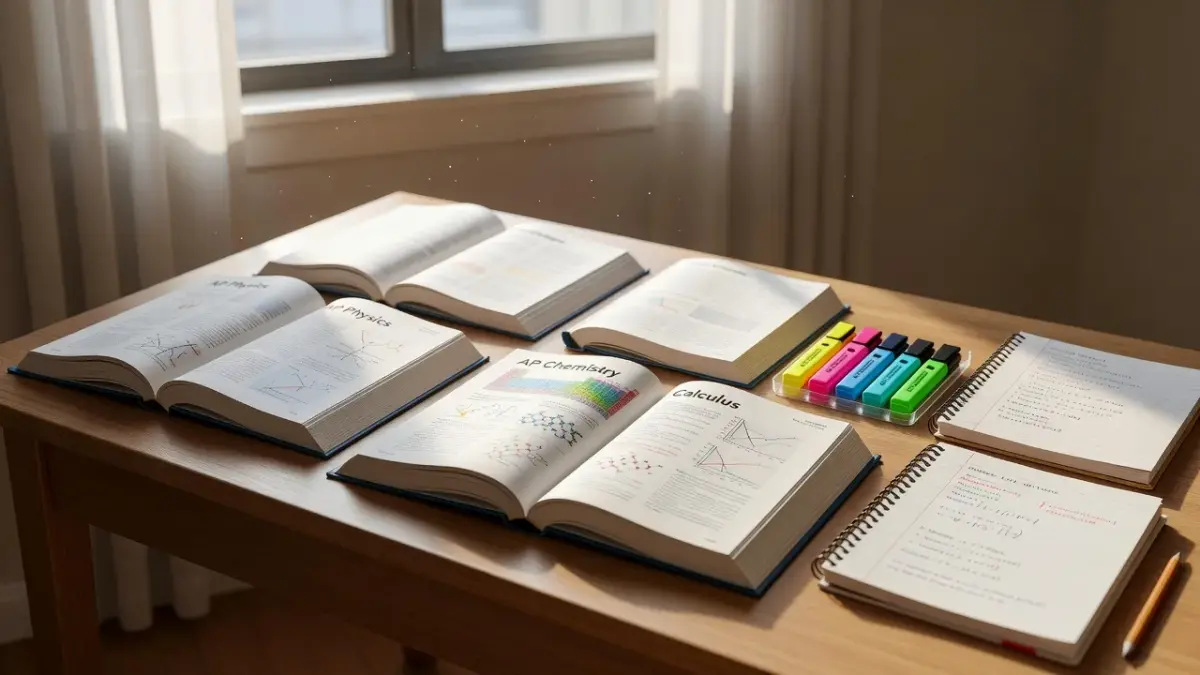
The hardest AP classes based on exam pass rates, student feedback, and conceptual depth are AP Physics C: Electricity and Magnetism, AP Chemistry, AP Physics 1, AP Calculus BC, and AP US History. While difficulty varies based on personal strengths in math or memorization, these six courses consistently record lower pass rates, heavy homework loads, and steep learning curves that challenge even top-performing high school students.
When stacking your schedule with college-level courses, taking too many rigorous AP classes at once can sink your grade point average. Before committing to three or four rigorous AP courses, you should run your target grades through GradeMath's weighted gpa calculator to see how an unexpected 'C' or 'B' will impact your overall transcript.
Which AP classes do students say are the hardest?
Students consistently rate AP Physics C: Electricity and Magnetism, AP Chemistry, and AP Physics 1 as the hardest AP classes. Self-reported difficulty surveys across high school forums point to AP Physics C (E&M) as the single most challenging course due to its reliance on calculus applied to abstract vector fields.
Student difficulty rankings generally group into three distinct categories based on the type of work required:
- Calculus-Based Physics: AP Physics C: E&M and AP Physics C: Mechanics require concurrent or prerequisite calculus knowledge.
- Heavy Concept Math & Chemistry: AP Chemistry and AP Calculus BC demand fast problem-solving speed and multi-step analytical logic.
- High-Volume Humanities: AP US History (APUSH), AP European History, and AP English Literature require reading hundreds of pages of primary sources and writing high-speed essays under time limits.
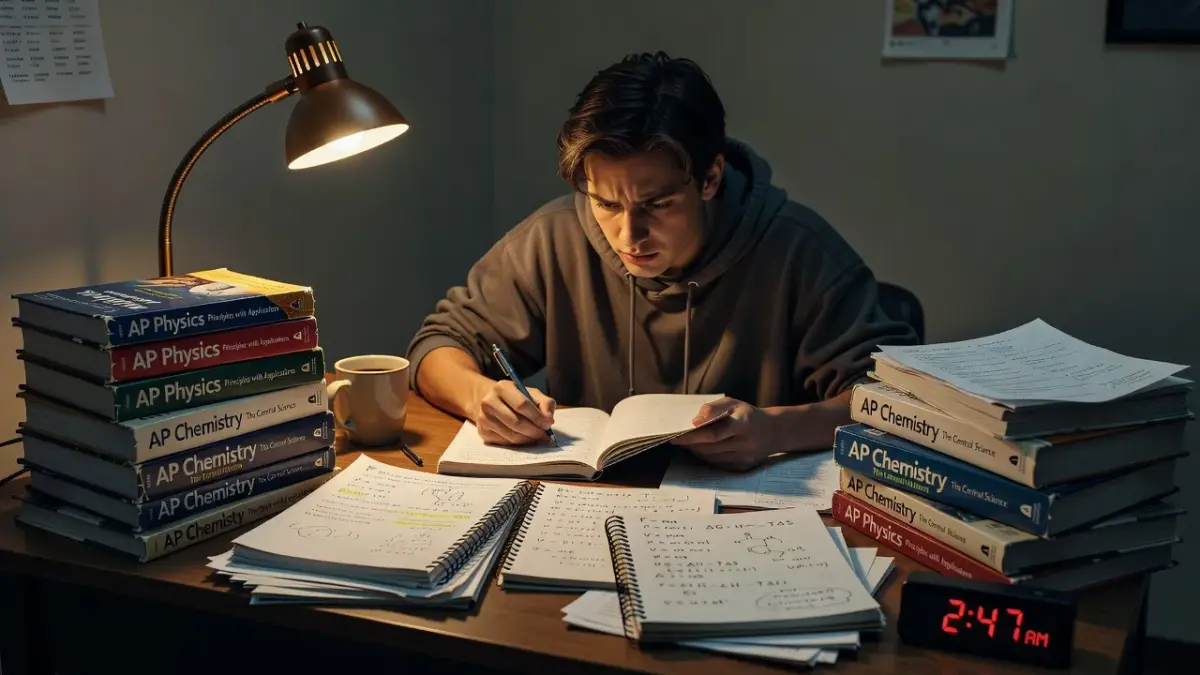
Which AP classes do teachers say are the hardest?
AP teachers rank AP Physics 1, AP Chemistry, and AP European History as the hardest classes to teach because students must master college-level synthesis rather than simple memorization. Instructors note that high school sophomores and juniors often struggle when transitioning from standard classes to AP courses that test conceptual transfer.
According to veteran Advanced Placement educators, the main pedagogical hurdles include:
- The Non-Intuitive Leap in AP Physics 1: Students expect formula plugging, but the exam focuses almost entirely on conceptual reasoning, paragraph-length explanations, and experimental design.
- The Speed of AP Calculus BC: Teachers must cover all of AP Calculus AB in the first semester before moving into parametric equations, polar coordinates, and complex infinite series in the second semester.
- The Essay Rigor in AP History & Literature: Teachers find that students struggle most with Document-Based Questions (DBQs) and synthesis essays, which require constructing an argument using raw historical documents in under 45 minutes.
Which AP exams have the lowest pass rates?
AP Physics 1, AP Environmental Science, AP US History, and AP Human Geography consistently record some of the lowest pass rates among all Advanced Placement exams. According to official score summaries published by the College Board, AP Physics 1 frequently records a pass rate (scores of 3, 4, or 5) hovering between 45% and 48%.
Low pass rates do not always mean a class is the most complex subject conceptually. Often, low pass rates stem from student demographics and self-selection bias:
- Introductory AP Courses: Classes like AP Human Geography, AP Environmental Science, and AP Physics 1 are often taken by freshmen or sophomores who have never experienced college-level testing.
- Advanced Selection Bias: Classes like AP Calculus BC and AP Physics C carry high pass rates (often over 75%) because only students with elite math preparation enrol in them.
What percentage of students score 3 or higher on each AP exam by subject?
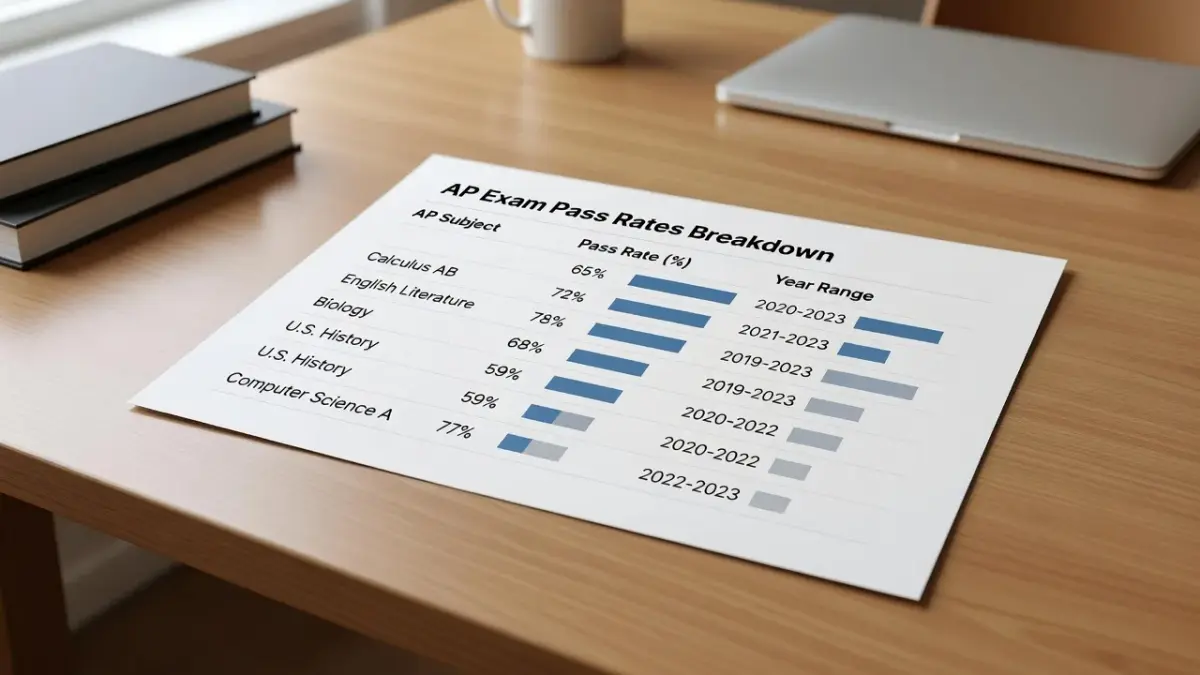
Pass rates for hard AP exams range from roughly 45% on introductory STEM tests to over 78% on highly specialized calculus courses. The table below breaks down recent exam performance and estimated weekly study hours based on College Board reporting and high school course survey data.
| AP Class Name | Pass Rate (Score 3+) | 5 Score Rate | Key Challenge Area | GPA Risk Level |
|---|---|---|---|---|
| AP Physics C: E&M | ~70% | ~30% | Multivariable calculus & fields | Extreme |
| AP Chemistry | ~75% | ~16% | Complex lab logic & math | High |
| AP Physics 1 | ~48% | ~8% | Conceptual physics explanations | Extreme |
| AP Calculus BC | ~78% | ~42% | Rapid pacing & Taylor series | High |
| AP US History (APUSH) | ~48% | ~13% | Massive reading volume & DBQs | High |
| AP English Literature | ~74% | ~14% | Speedy poetry & prose analysis | Moderate |
| AP Physics C: Mechanics | ~74% | ~25% | Calculus applied to motion | High |
| AP Biology | ~64% | ~14% | Data interpretation & labs | Moderate |
| AP European History | ~59% | ~13% | Historical synthesis & essays | High |
| AP Art History | ~64% | ~13% | Memorizing 250 visual works | Moderate |
Data reflects historical distributions verified in College Board exam scoring reports.
How to calculate the GPA impact of taking hard AP classes
A single low grade in an AP class can pull down your cumulative unweighted GPA even if your school awards an extra weighted point. While high schools usually scale an 'A' in an AP class to a 5.0 weighted score, a 'C' in that same AP course yields only a 3.0 weighted score - which equals a standard 'B' in a regular class while dropping your unweighted mark to a 2.0.
Understanding how weighted credit interacts with college admissions requires looking at two numbers:
- Unweighted GPA: Evaluates your raw academic performance on a standard 4.0 scale regardless of course difficulty.
- Weighted GPA: Reflects course rigor by adding quality points (typically +1.0 for AP/IB and +0.5 for Honors).
Before adding three heavy AP courses to your junior-year schedule, calculate your break-even point. If taking an extra AP course drops your grade from an 'A' to a 'C', the trade-off usually harms your overall profile.
To plan your schedule safely, plug your current grades into GradeMath's cumulative gpa calculator. Seeing your exact project weighted trajectory helps you decide whether to drop an unmanageable AP course before your school's transcript deadline. You can also review our guide on how to calculate GPA using current GPA to understand how upcoming semester grades shift your college application numbers.
Is AP Physics C or AP Calculus BC harder?
AP Physics C is generally considered harder than AP Calculus BC because it requires you to apply calculus to abstract physical phenomena rather than solving isolated math equations. While AP Calculus BC covers a vast amount of material quickly, the problem types follow predictable algorithmic steps once you master integration and series techniques.
Here is how the two compare across key academic dimensions:
- Mathematical Depth: AP Calculus BC goes deeper into pure math theories, including polar coordinates, parametric equations, and Taylor series.
- Application & Logic: AP Physics C requires you to translate a word problem describing a physical setup into a calculus framework before solving it.
- Prerequisites: Students can take Calculus BC after Honors Pre-Calculus, whereas Physics C usually requires prior physics background plus calculus proficiency.
For students deciding between the two during senior year, Calculus BC is often the safer choice unless you intend to major in engineering or physics in college.
How hard are AP Chemistry, AP Biology, AP US History and AP English Literature?
AP Chemistry and AP US History are widely considered the hardest non-physics AP classes due to their heavy workload and dense exam formats. These four courses represent the core foundation of traditional high school AP programs, but each poses distinct academic hurdles.
How hard is AP Chemistry?
AP Chemistry is exceptionally hard because it combines multi-step mathematical calculations with abstract molecular concepts. Students must navigate stoichiometry, equilibrium constants, thermodynamics, and electrochemistry while conducting detailed laboratory write-ups. Unlike introductory chemistry, the AP exam gives minimal credit for basic memorization and focuses on experimental problem-solving.
How hard is AP Biology?
AP Biology is moderately difficult, having shifted its curriculum away from rote memorization toward data interpretation and lab analysis. The current exam format tests your ability to read scientific charts, analyze experimental setups, and apply biological concepts to unfamiliar scenarios. While the reading load is heavy, students strong in logic and reading comprehension often find it more manageable than AP Chemistry.
How hard is AP US History (APUSH)?
AP US History is notoriously difficult due to the sheer volume of historical facts, dates, and essay structures you must master. Covering American history from 1491 to the present, APUSH requires students to complete weekly textbook readings of 30 to 50 pages. The exam tests endurance through 55 multiple-choice questions, three short-answer questions, one long essay, and a Document-Based Question (DBQ).
How hard is AP English Literature?
AP English Literature is challenging for students who struggle with speed-reading, figurative language analysis, and spontaneous essay writing. Unlike AP English Language, which focuses on non-fiction rhetoric, AP Lit requires analyzing poetry, drama, and classic fiction. The hardest task on the exam is Question 3, which asks you to write an in-depth essay on a literary work of your choice from memory.

The 7 Hardest AP Classes Ranked
The top 7 hardest AP classes ranked by conceptual difficulty, workload, and exam challenge are AP Physics C: E&M, AP Chemistry, AP Calculus BC, AP Physics 1, AP US History, AP English Literature, and AP Biology. Below is an analysis of why each course earned its spot on the list and who should take it.
1. AP Physics C: Electricity and Magnetism
AP Physics C: E&M claims the top spot as the most difficult AP course offered in high schools. The class explores Gauss's Law, magnetic fields, Maxwell's equations, and electromagnetic induction using differential and integral calculus.
- Why it made the list: The concepts are highly abstract and impossible to visualize without advanced vector calculus logic.
- Key trade-off: Taking this course demonstrates elite STEM rigor to top universities, but an unearned 'C' can severely damage your weighted GPA.
2. AP Chemistry
AP Chemistry takes second place due to its rapid pacing, intense laboratory requirements, and mathematical breadth. You must synthesize concepts across multiple units, such as linking molecular structure to reaction rates and free energy changes.
- Why it made the list: Test questions frequently combine three different chemistry topics into a single free-response question.
- Key trade-off: It provides valuable college credit for pre-med and engineering majors, but requires 5 to 8 hours of homework weekly.
3. AP Calculus BC
AP Calculus BC ranks third because it covers two full semesters of college calculus in a single academic year. It encompasses everything in AP Calculus AB plus vector functions, integration by parts, radius of convergence, and Taylor series.
- Why it made the list: The sheer speed of instruction leaves little room to catch up if you fall behind on fundamental integration skills.
- Key trade-off: Scoring a 4 or 5 opens up double college math credits, but students without solid pre-calculus foundations risk failing quizzes early on.
4. AP Physics 1
AP Physics 1 holds the fourth spot due to its notoriously low national pass rate and deceptive exam questions. Despite using simple algebra, the course forces students to explain the "why" behind mechanical systems using written prose and free-body diagrams.
- Why it made the list: Multiple-choice questions feature tricky distractors that catch students relying on simple formula plug-and-chug methods.
- Key trade-off: It provides an introductory physics foundation, but offers limited college credit at major universities compared to Physics C.
5. AP US History (APUSH)
AP US History ranks fifth as the hardest humanities course in high school. The difficulty comes from memorizing nine distinct historical eras and applying analytical frameworks under strict exam timing constraints.
- Why it made the list: The Document-Based Question (DBQ) essay requires analyzing seven primary sources while weaving in outside historical evidence in under 60 minutes.
- Key trade-off: It builds essential college essay writing skills, but consumes more nightly reading time than almost any other course.
6. AP English Literature and Composition
AP English Literature takes the sixth spot because of its open-ended grading standards and demanding poetry analysis. Students must decipher archaic poetry, analyze tone shifts, and write insightful prose essays under timed conditions.
- Why it made the list: Scoring high marks on the 6-point AP grading rubric requires stylistic vocabulary and advanced literary intuition that cannot be memorized overnight.
- Key trade-off: It refines critical thinking skills, but grading scale variances between teachers make earning an 'A' difficult.
7. AP Biology
AP Biology rounds out the top seven due to its massive vocabulary load and emphasis on experimental data analysis. The modern curriculum requires applying biological principles to unexpected laboratory scenarios.
- Why it made the list: The exam features long, wordy questions accompanied by multi-variable graphs and Chi-Square statistical analysis.
- Key trade-off: It is ideal for aspiring life science majors, but requires significant memorization alongside mathematical lab calculations.
How many hard AP classes should you take in high school?
Most selective college applicants take between 7 and 12 total AP classes across their entire high school career, averaging 2 to 4 per year during junior and senior years. Admitted student data reported by top university admissions offices - including public systems like the University of California - shows that admissions officers evaluate course rigor within the context of what your specific high school offers.
To build a balanced schedule without burning out, follow this recommended progression:
- Freshman Year: 0 to 1 introductory AP class (e.g., AP Human Geography).
- Sophomore Year: 1 to 2 manageable AP classes (e.g., AP World History, AP Seminar, or AP Environmental Science).
- Junior Year: 2 to 4 core AP classes balancing STEM and humanities (e.g., APUSH, AP English Language, AP Calculus AB or BC).
- Senior Year: 3 to 5 advanced AP classes suited to your college major (e.g., AP Chemistry, AP Physics C, AP Macroeconomics).
Always prioritize keeping high unweighted grades over overloading your schedule with hard AP courses that tank your transcript performance.
Frequently Asked Questions
What is the easiest AP class to take?
AP Computer Science Principles, AP Human Geography, and AP Environmental Science are widely considered the easiest AP classes. These courses feature lower reading requirements, straightforward exam formats, and higher average classroom grades compared to core STEM or history subjects.
Should I take AP Physics 1 or AP Chemistry first?
You should generally take AP Chemistry after completing basic algebra and introductory chemistry, while AP Physics 1 is best taken after completing Geometry and Algebra 2. Most schools recommend taking AP Chemistry during sophomore or junior year before attempting AP Physics 1 or AP Physics C.
How many AP classes should I take in high school?
Taking 6 to 10 total AP classes across high school is typical for students aiming for competitive four-year universities. Highly selective institutions evaluate course load within the context of your school's curriculum offerings rather than setting a strict numerical requirement.
Does getting a 'C' in an AP class look bad for college admissions?
Yes, earning a 'C' in an AP class can hurt your application at selective colleges because it lowers your cumulative unweighted GPA below standard thresholds. While admissions officers value academic challenge, a 'B' in an Honors course is generally preferred over a 'C' in a difficult AP course.
Is AP Calculus AB or BC a better choice?
AP Calculus AB is better for students who want a thorough introduction to differential and integral calculus, while Calculus BC is ideal for strong math students prepared for double pacing. Calculus BC covers all AB topics in its first semester before tackling advanced college-level math topics in the second semester.
Can self-studying for an AP exam lower my high school GPA?
No, self-studying for an AP exam does not affect your high school GPA because self-studied exam scores appear on your College Board score report rather than your high school transcript. However, the study time required for self-studying can distract from your actual high school classwork, indirectly impacting your semester grades.
Is AP Art History harder than AP European History?
AP European History is generally considered harder than AP Art History due to its heavier writing demands and complex essay rubrics. However, AP Art History requires memorizing 250 specific artworks along with their historical context, culture, and formal qualities.