

To calculate your cumulative GPA using your current GPA, multiply your existing overall GPA by your total earned credit hours to find your previous quality points, add the new quality points earned from your current term, and divide that combined total by your total cumulative credit hours. This credit-weighted formula gives you your exact updated grade point average across all semesters without starting your math from scratch.
When students try to calculate GPA with current GPA numbers mid-year, the single most common mistake is taking a simple average of two GPAs. Taking a 3.5 prior GPA and a 3.0 semester GPA and calling it a 3.25 ignores credit weighting entirely. If you have 60 credits behind that 3.5 and only 12 credits in the 3.0 term, your true updated GPA is actually 3.42. Relying on an unweighted average gives you an inaccurate picture that can derail academic planning, honors eligibility, or college application prep.
The step-by-step method below prevents that math error and works for both high school and college credit systems.
Steps at a Glance: Calculating Updated GPA from Current GPA
The table below outlines the necessary steps to calculate GPA using current GPA data, along with the required inputs and estimated time for each step.
| Step | Instruction | What You Need | Estimated Time |
|---|---|---|---|
| 1 | Gather prior cumulative metrics | Current GPA and total earned credit hours | 2 minutes |
| 2 | Calculate baseline quality points | Current GPA × total earned credits | 1 minute |
| 3 | Convert current grades to points | Letter grades for new courses and course credit values | 3 minutes |
| 4 | Sum total quality points | Baseline quality points + new course quality points | 1 minute |
| 5 | Divide by total combined credits | Total quality points ÷ total combined credits | 1 minute |
Step 1: Gather Your Current GPA and Total Earned Credits
Locate your most recent unofficial transcript or student portal dashboard to find your overall cumulative GPA and total earned credit hours (or units). Do not use your term GPA from last semester alone unless that was your very first term. You need the overall numbers reflecting every completed course up to this point.
If your school operates on a high school credit system, credits are usually measured in full units (1.0 credit per year-long course) or half units (0.5 credits per semester course). In college, standard lecture classes typically carry 3 or 4 credit hours, while science labs or physical education electives might carry 1 or 2 credit hours.
Keep in mind that classes marked as Pass/Fail, Audited, or Incomplete do not carry grade point values and should not be included in your credit totals for GPA math.

Step 2: Calculate Your Baseline Quality Points
Multiply your current cumulative GPA by your total earned credit hours to determine your prior quality points. Schools compute GPA using a quality point system where letter grades correspond to numerical values on a 4.0 scale.
The standard conversion defined by the College Board assigns the following values:
- A = 4.0
- B = 3.0
- C = 2.0
- D = 1.0
- F = 0.0
To reverse-engineer your total quality points accumulated across prior semesters, use this exact formula:
$$\text{Baseline Quality Points} = \text{Current Cumulative GPA} \times \text{Total Prior Credits}$$
For instance, if you currently hold a 3.40 cumulative GPA across 45 earned credit hours:
$$\text{Baseline Quality Points} = 3.40 \times 45 = 153.0$$
This single number represents every grade point you have banked since your first day of high school or college.
Step 3: Convert Your Current Classes to New Quality Points
Assign numerical grade values to each class in your current term, then multiply each class value by its individual credit hours. This gives you the quality points earned in your current semester.
If your school uses plus and minus grade scales, consult your institution's specific policy. As an example, Stanford University Registrar guidelines set an A- at 3.7 grade points and a B+ at 3.3 grade points, whereas some high schools assign flat values for whole letter grades.
Here is how you calculate points for a sample current term schedule:
- English 101 (3 credits): Expected Grade A (4.0) $\rightarrow 3 \times 4.0 = 12.0\text{ points}$
- Calculus I (4 credits): Expected Grade B (3.0) $\rightarrow 4 \times 3.0 = 12.0\text{ points}$
- Chemistry with Lab (4 credits): Expected Grade B+ (3.3) $\rightarrow 4 \times 3.3 = 13.2\text{ points}$
- History 201 (3 credits): Expected Grade A- (3.7) $\rightarrow 3 \times 3.7 = 11.1\text{ points}$
To get your total new quality points for the semester, add these products together:
$$12.0 + 12.0 + 13.2 + 11.1 = 48.3\text{ new quality points}$$
Next, sum the credit hours for this new semester:
$$3 + 4 + 4 + 3 = 14\text{ new credit hours}$$
Step 4: Combine Past and Present Quality Points
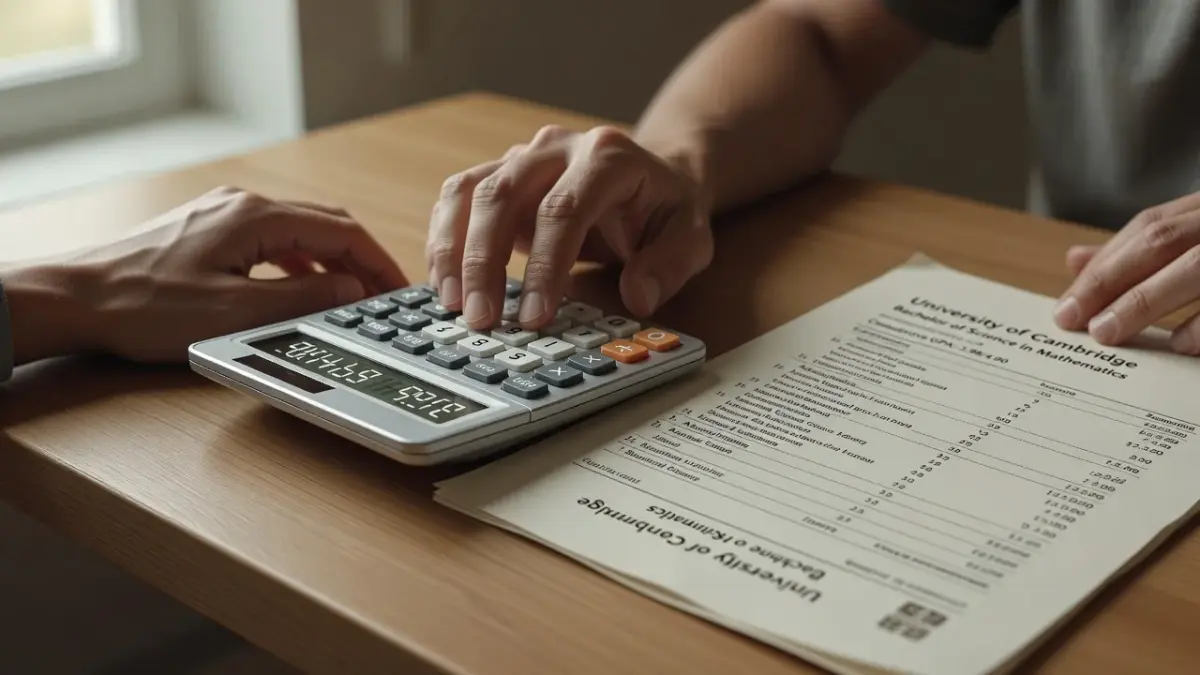
Add your baseline quality points from Step 2 to your new semester quality points from Step 3. This calculation yields your updated grand total of quality points.
Using our running numbers:
- Baseline Quality Points: 153.0
- New Semester Quality Points: 48.3
$$\text{Grand Total Quality Points} = 153.0 + 48.3 = 201.3$$
Simultaneously, add your prior credit hours to your current term credit hours:
- Prior Earned Credits: 45
- New Semester Credits: 14
$$\text{Total Combined Credits} = 45 + 14 = 59$$
Step 5: Divide Total Quality Points by Combined Credits
Divide your grand total quality points by your total combined credit hours to calculate your new overall cumulative GPA.
The formula is:
$$\text{Updated Cumulative GPA} = \frac{\text{Grand Total Quality Points}}{\text{Total Combined Credit Hours}}$$
Applying the totals from Step 4:
$$\text{Updated Cumulative GPA} = \frac{201.3}{59} = 3.4118$$
Rounding to the standard two decimal places gives an updated cumulative GPA of 3.41.
Notice how adding a 3.45 term GPA (48.3 points ÷ 14 credits) to a 3.40 prior GPA over 45 credits shifted the total cumulative figure by just 0.01 points. Because 45 credit hours carry significantly more weight than 14 credit hours, earlier grades buffer your overall average against drastic jumps.
Worked Example: High School vs. College GPA Adjustments
Calculating your GPA requires adjusting for your school's specific weighting rules, as high school weighted scales and college scale variations treat course credits differently.
In high school, Advanced Placement (AP), International Baccalaureate (IB), and Honors courses frequently use a 5.0 weighted scale. According to policy summaries on Harvard College's handbook page, college admissions officers re-evaluate high school GPAs using specific unweighted or recalculated standards. However, for internal class rank, an AP course with an A often contributes 5.0 quality points per credit instead of 4.0. Fairfax County students can see one district's version in the FCPS GPA scale guide.
In college, weighting by course rigor does not exist, but credit volume varies widely. A 5-credit lab science carries nearly double the impact of a 3-credit lecture class on your final calculation.
Here is a side-by-side view comparing how high school weighted courses and college credit weightings change the math:
HIGH SCHOOL WEIGHTED EXAMPLE:
Current Cumulative GPA: 3.60 across 12 full course units
Baseline Quality Points = 3.60 x 12 = 43.2

Current Term (Weighted AP scale):
- AP Literature (1 unit): A (5.0 points)
- AP Chemistry (1 unit): B (4.0 points)
- Honors Algebra (1 unit): A (4.5 points)
New Term Points = 5.0 + 4.0 + 4.5 = 13.5 points across 3 units

Grand Total Points = 43.2 + 13.5 = 56.7
Total Units = 12 + 3 = 15
Updated Weighted GPA = 56.7 / 15 = 3.78
COLLEGE UNWEIGHTED EXAMPLE:
Current Cumulative GPA: 2.85 across 30 credit hours
Baseline Quality Points = 2.85 x 30 = 85.5

Current Term (Standard 4.0 scale):
- Psychology (3 credits): A (4.0 points x 3 = 12.0)
- Statistics (4 credits): A- (3.7 points x 4 = 14.8)
- Biology Lab (2 credits): B (3.0 points x 2 = 6.0)
New Term Points = 12.0 + 14.8 + 6.0 = 32.8 points across 9 credits

Grand Total Points = 85.5 + 32.8 = 118.3
Total Credits = 30 + 9 = 39
Updated College GPA = 118.3 / 39 = 3.03
Calculating Target GPAs for Applications and Honors
To reach a specific target GPA before college applications or graduation, you must calculate the exact average grade required in your remaining credit hours.
If you are tracking progress toward minimum requirements for scholarships, graduate school admissions, or honors distinctions, working backward tells you whether your target is mathematically achievable.
Use this target formula:
$$\text{Required Term GPA} = \frac{(\text{Target Cumulative GPA} \times \text{Future Total Credits}) - \text{Current Quality Points}}{\text{Remaining Term Credits}}$$
As of November 2026, most US college portals allow students to run hypothetical degree audit scenarios, but performing the math directly keeps your planning accurate.
Suppose you have 60 earned credits with a 3.10 GPA (186 quality points) and want to hit a 3.30 cumulative GPA by the end of your next term (15 credits):
- Future Total Credits: $60 + 15 = 75\text{ credits}$
- Required Total Quality Points: $3.30 \times 75 = 247.5\text{ points}$
- Needed Quality Points in Next Term: $247.5 - 186.0 = 61.5\text{ points}$
- Required Term GPA: $\frac{61.5}{15} = 4.10$
Because a standard unweighted 4.0 scale tops out at 4.00, achieving a 3.30 cumulative GPA within a single 15-credit semester is mathematically impossible in this scenario. You would need to spread the target over at least two full 15-credit semesters (30 total future credits):
$$\text{Required Quality Points over 30 credits} = (3.30 \times 90) - 186.0 = 297.0 - 186.0 = 111.0\text{ points}$$
$$\text{Required Average GPA over next 30 credits} = \frac{111.0}{30} = 3.70\text{ GPA}$$
A 3.70 average (A- average) over two semesters is achievable, providing a realistic roadmap for academic planning. Strong study habits and GPA rules for straight A's help you get there.
Streamlining Your Calculations with GradeMath
Manually converting letter grades to points and tracking credit weights can be tedious, but using dedicated online software reduces calculation errors.
If you want to skip manual calculations, GradeMath offers a free suite of intuitive tools built specifically for US middle school, high school, and college grading scales.
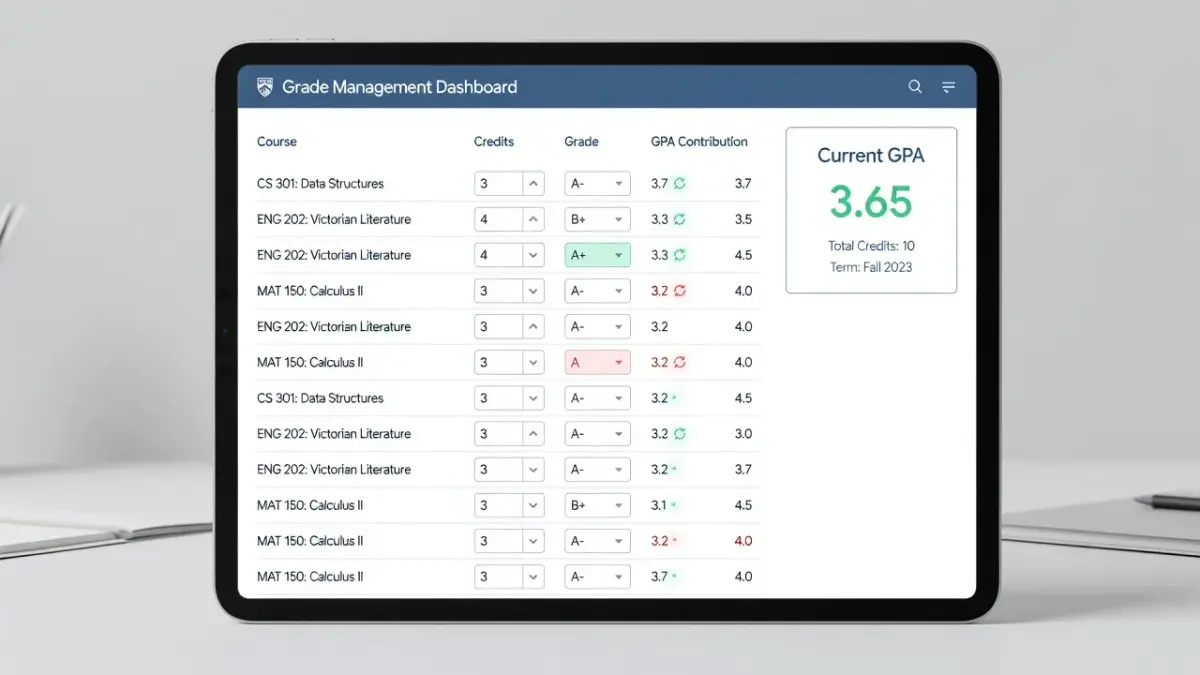
Instead of writing out quality point formulas, you can open the cumulative gpa calculator on GradeMath, enter your existing cumulative GPA alongside your prior credits, and type in your current course list. The platform automatically handles university-specific +/- grading variations, AP/Honors high school weightings, and target goal forecasting.
Whether you are using the primary gpa calculator to check semester performance or the high school gpa calculator to verify weighted class ranks, GradeMath handles the underlying quality point math instantly.
Common Mistakes When Calculating GPA with Current GPA
Avoiding math errors during grade projection requires recognizing four key pitfalls that skew cumulative calculations.
- Averaging GPAs Directly: As established, averaging a prior 3.8 GPA with a current 3.0 semester GPA yields 3.4 only if both periods contain the exact same number of credit hours. Always convert to quality points first.
- Including Pass/Fail or Audited Classes in Credit Totals: Pass/Fail (P/F) or Satisfactory/Unsatisfactory (S/U) credits count toward degree completion but carry zero grade points. If you add 3 pass/fail credits to your denominator without adding quality points to your numerator, your calculated GPA will drop artificially.
- Forgetting Repeated Course Rules: If you retake a course to replace an earlier grade, your school's registrar policy dictates whether the old grade is removed from your cumulative quality points or averaged together.
- Mixing Weighted and Unweighted Scale Values: Combining high school weighted course points (e.g., a 5.0 AP A) with an unweighted baseline transcript scale skews your overall average. Stick to one consistent scale across all terms. Before adding weighted courses, see which AP courses carry the biggest GPA risk.
Frequently Asked Questions
Can you calculate current GPA by averaging semester GPAs?
No, you cannot calculate cumulative GPA by taking a simple average of semester GPAs unless every semester contains the exact same number of credit hours. You must multiply each semester's GPA by its credit hours to find total quality points, sum those points, and divide by total earned credits.
How do I calculate my overall GPA if I don't know my total past credit hours?
If you do not know your total past credit hours, check your student portal or unofficial transcript. If credits are unlisted, you can estimate by multiplying the number of courses completed by your school's average credit value per course, though your resulting GPA will be an approximation.
Does a 0-credit course affect my cumulative GPA calculation?
No, a 0-credit course carries no credit weight and adds zero quality points to your totals. It has no effect on your calculated grade point average, regardless of the letter grade assigned.
How do retaken classes affect calculating GPA with current GPA?
If your school replaces retaken grades, subtract the old course's quality points and credits from your baseline totals before adding the new grade's quality points and credits. If your school averages retakes, treat the new course as an entirely separate entry in your current term.
Is college GPA calculated differently than high school GPA?
College GPA uses credit hours (typically 1 to 5 per course) and unweighted scales (4.0 max), whereas high school GPA often uses course units (0.5 or 1.0) and may incorporate weighted scales (up to 5.0) for AP or Honors courses.
How do plus and minus grades affect cumulative GPA math?
Plus and minus grades adjust standard letter grade values up or down by 0.3 grade points on most scales. For example, a B+ is worth 3.3 grade points, a B is worth 3.0, and a B- is worth 2.7 grade points per credit hour.
How many credits do I need to raise my GPA by 0.1?
The credits required to raise your GPA by 0.1 depend on your total accumulated credits and your future semester GPA. The more credits you have already completed, the more future high-grade credits you will need to shift your cumulative average.