

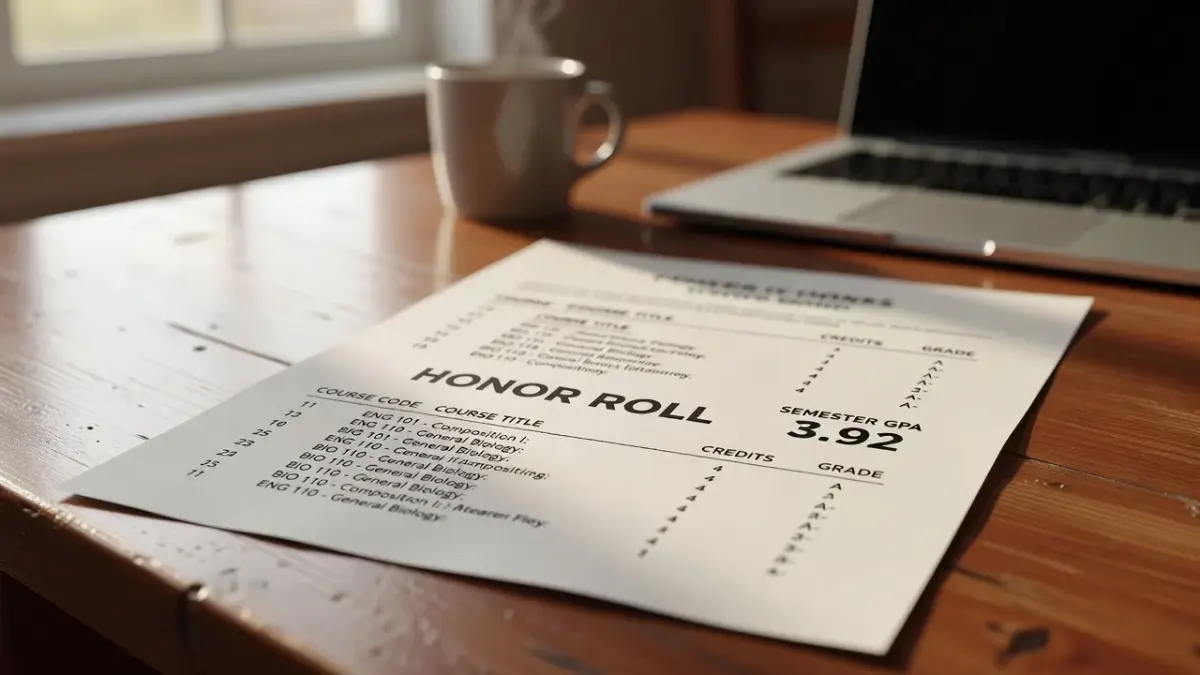
A Dean's List is an academic honor awarded by US colleges and universities to undergraduate students who achieve a high grade point average (GPA) - typically 3.50 or higher - during a single academic term while enrolled full-time. Unlike cumulative graduation honors that measure your performance across all four years, this award evaluates your performance strictly on a semester or quarter basis. If you are tracking your current term grades to see if you qualify this semester, our free college GPA calculator at GradeMath helps you map out your exact standing based on your credit hours and expected grades.
What is a Dean's List and how does it work?
A Dean's List is a term-by-term academic honor roll published by the dean of a specific college or school within a university. When you qualify, your name is published on an official term roster, and a notation is placed directly on your academic transcript for that semester.
Understanding what the Dean's List means comes down to three operational rules:
- Term-specific evaluation: Your eligibility resets every semester or quarter. A bad fall semester does not prevent you from making the list in the spring.
- Full-time credit load: Universities almost always require a minimum of 12 letter-graded credit hours in the given term.
- School-level thresholds: Because universities contain distinct colleges (such as a College of Engineering versus a College of Arts and Sciences), the Dean's List GPA minimum often varies across departments on the same campus.
What are typical Dean's List GPA requirements at US universities (3.5, 3.7, 3.8)?
The standard Dean's List GPA threshold across most US universities falls between 3.50 and 3.75 on a standard 4.0 scale. However, benchmark levels depend heavily on institutional policy, with some elite public and private schools setting their cutoffs as high as 3.75 or 3.80.
Here is how common GPA cutoffs break down across standard university tiers:
- 3.50 GPA cutoff: The most common benchmark at public state universities and mid-sized liberal arts colleges. This typically requires a mix of A and B grades with no grade below a B minus.
- 3.65 to 3.70 GPA cutoff: Often used by competitive professional colleges within larger universities, such as business or nursing schools.
- 3.75 to 3.80 GPA cutoff: Common at top-tier research institutions and highly selective private colleges that maintain strict grade cutoffs.
The table below outlines the credit rules, GPA minimums, and strict disqualification criteria across representative US higher education systems, as verified in late 2026.
| Institution / Category | Minimum Term GPA | Minimum Graded Credits | Strict Disqualification Limits |
|---|---|---|---|
| University of Michigan (LSA) | 3.800 | 12 letter-graded credits | Incomplete grades, pass/fail credits below threshold |
| Standard State University | 3.500 | 12 letter-graded credits | Grades below C, audit courses, part-time status |
| Typical Community College | 3.500 | 12 letter-graded credits | Remedial non-credit courses, incomplete marks |
| Harvard University | No Dean's List | N/A | Term honor list was discontinued |
| Stanford University | No Dean's List | N/A | Term honor list not maintained |
| MIT | No Dean's List | N/A | Term honor list not maintained |
What GPA does the University of Michigan require for the Dean's List?
The University of Michigan College of Literature, Science, and the Arts (LSA) requires a minimum term GPA of 3.800 for its Dean's List. According to the official University of Michigan LSA Academic Policies, students must complete at least 12 letter-graded credits during the fall or winter term to be eligible.
If you carry courses graded on a pass/fail or credit/no-credit basis, those hours do not count toward the 12-credit threshold. Furthermore, if you carry an unresolved "Incomplete" (I) mark on your record when honors are calculated, you are automatically disqualified for that term.
Does Harvard have a Dean's List, and what GPA is required?
No, Harvard University does not publish a traditional term Dean's List for undergraduate students. Harvard College phased out term honor rolls to discourage grade competition and focus student evaluation on year-end and graduation distinctions.
Instead of term honors, academic recognition at Harvard is documented through official publications in the Harvard College Handbook via annual rank list groups and end-of-year awards. Students aiming for academic distinction at Harvard must focus on cumulative performance for Latin Honors (cum laude, magna cum laude, and summa cum laude) upon graduation.

What is the Stanford Dean's List GPA requirement?
Stanford University does not maintain an undergraduate Dean's List for term GPAs. As outlined by the Stanford University Registrar, the university avoids quarterly GPA ranking lists for undergraduate students.
Rather than relying on term GPA badges, Stanford recognizes high academic achievement through departmental honors programs, capstone research awards, and election to national academic honor societies like Phi Beta Kappa.
What is the MIT Dean's List GPA requirement?
Massachusetts Institute of Technology (MIT) does not have a Dean's List for any undergraduate program. Policy documentation from the MIT Registrar's Office shows that the institute deliberately omits term academic honor rolls to support a collaborative learning environment.
First-semester freshmen at MIT receive grades on a Pass/No Record scale, which prevents GPA calculation entirely during their initial term. Upperclassmen receive standard letter grades, but the university tracks academic progress through internal department honors rather than public GPA lists.
What GPA is required for the Dean's List at community colleges?
Most community colleges require a minimum term GPA of 3.50 for their Dean's List, along with full-time enrollment of at least 12 credit hours. Many two-year institutions also publish a secondary honor roll, often called the President's List, reserved exclusively for students earning a perfect 4.00 term GPA.
However, community college students must pay close attention to course types. Developmental or remedial courses (often numbered below 100) rarely generate letter-grade honor points. If six of your 12 enrolled credits are in non-credit remedial math, you only have six letter-graded credits, which leaves you ineligible for the Dean's List for that semester.
What rules and limits can disqualify you from the Dean's List?
Failing to meet credit-type rules or carrying unresolved course marks will disqualify you from the Dean's List, even if your numerical GPA exceeds the cutoff. Understanding these structural boundaries is vital because high grades alone do not guarantee a spot on the honor roll.
The primary disqualification traps include:
- Pass/Fail credit limits: Courses taken as Pass/Fail, Satisfactory/Unsatisfactory, or Credit/No-Credit do not contribute to your letter-graded GPA total. If you take 15 total credits but 4 are Pass/Fail, you only have 11 graded credits - falling short of the typical 12-credit rule.
- Incomplete (I) grades: If a professor grants you an extension past final exams, an "I" grade appears on your temporary record. Most university registrars finalize Dean's List rosters immediately after semester grades close, excluding anyone with pending marks.
- Academic probation or disciplinary history: Students with active academic integrity violations or conduct holds are generally ineligible for university honor lists regardless of their academic average.
- Part-time status: Dropping a single class mid-semester can drop your load from 12 credits to 9 credits, stripping your eligibility for term honors.
How to verify your Dean's List eligibility before finals
Calculating your target term GPA manually when classes have different credit values (such as a 4-credit lecture versus a 1-credit lab) often leads to mistakes. If you want to know what grades you need on your remaining assignments and exams, you can test your target scores with our free cumulative GPA calculator and standard grade utilities at GradeMath. Using a dedicated calculator lets you account for unweighted scales so you can verify your term standing before final grades post.
Does making the Dean's List actually matter for your career?
Making the Dean's List provides short-term value for undergraduate scholarship applications and entry-level resumes, but its impact diminishes quickly after your first job. Employers focus primarily on your overall cumulative GPA, relevant internships, and practical skills.
Here is where earning term honors makes a real difference:
- Competitive scholarships: Many internal university awards require applicants to maintain a record of term honors.
- First-job resumes: Listing "Dean's List (4 Semesters)" under your education section proves consistent performance to recruiters when you lack extensive work experience.
- Graduate school applications: Admissions officers for master's programs look for positive academic trends. Earning Dean's List honors during your junior and senior years shows strong academic growth after a slow start.
If you are planning for specialized post-graduate programs, learning how to calculate your GPA using current grades helps you monitor both your term performance and your cumulative average over time.
How to calculate your term GPA for Dean's List eligibility
To calculate your term GPA, multiply the quality point value of each letter grade by the course credit hours, sum those totals, and divide by your total letter-graded credit hours.
Follow these four steps to find your exact standing:
- Convert letter grades to quality points: Standard 4.0 scales assign 4.0 for an A, 3.0 for a B, 2.0 for a C, 1.0 for a D, and 0.0 for an F. (Plus and minus grades add or subtract 0.33 points).
- Calculate grade points per course: Multiply the quality point value by the course credit count. A 4-credit course with an A- (3.67) yields 14.68 grade points.
- Add all grade points: Sum the total grade points earned across all eligible classes in the term.
- Divide by total letter-graded credits: Divide total grade points by the total number of letter-graded credit hours taken that semester.
If your final result matches or exceeds your department's published cutoff - and you met all credit-hour conditions - you have earned a spot on the Dean's List. To double-check your math across multiple semesters, you can rely on the tools available at GradeMath to keep your targets on track.
Frequently Asked Questions
Does Dean's List show on your official diploma?
No, Dean's List honors do not appear on your physical college diploma. Diplomas list your degree name, major, and cumulative Latin honors (cum laude). However, Dean's List recognition is permanently recorded on your official academic transcript under each qualifying semester.
Do part-time students qualify for the Dean's List?
Most colleges restrict the standard Dean's List to full-time students taking at least 12 letter-graded credits. However, some institutions offer a specialized "Part-Time Honors List" for non-traditional or adult learners who complete 6 to 11 credits in a term with high marks.
Is Dean's List based on term GPA or cumulative GPA?
Dean's List is calculated strictly using your term GPA for a single semester or quarter. Your overall cumulative GPA across all years determines graduation honors like cum laude, but it does not dictate term Dean's List standing.
What is the difference between Dean's List and President's List?
The President's List requires a higher GPA cutoff - usually a perfect 4.00 or 3.90 - than the Dean's List, which typically requires a 3.50 or 3.70. Both are term-based academic honors, but the President's List represents the highest academic tier at institutions that offer both.
Does making the Dean's List help with law school or medical school admissions?
Dean's List honors add modest value to professional school applications, but your overall cumulative GPA and entrance test scores carry far more weight. Admissions committees look closely at normalized cumulative metrics calculated by centralized processing services rather than individual semester honor badges.
Can high school students make the Dean's List?
High school students do not earn a traditional Dean's List honor unless they are dual-enrolled in college courses. High schools publish their own distinction rosters, usually called the "Honor Roll" or "Principal's List," which use separate unweighted or weighted GPA thresholds.