
A report card with all A's (commonly called a straight-A report card) represents a perfect 4.0 unweighted Grade Point Average for a grading period, signaling top-tier academic mastery across all enrolled subjects. Earning these marks requires maintaining percentage scores above your school's A threshold, which typically sits at 90% or 93% depending on the local district scale. If you are calculating whether your current test scores will keep your all As report card intact before final exams, using our free gpa calculator gives you an instant projection without manual math errors.
To understand why a report card with straight A's carries so much weight, you need to break down how academic systems evaluate performance. An A grade demonstrates complete mastery of class standards, but maintaining that score across four to seven distinct subjects every semester presents steep operational constraints.
The Path to an All-A Report Card
- Grading thresholds
- Unweighted 4.0 Scale (93-100% = A, 90-92% = A-)
- Weighted 5.0 Scale (Honors +0.5, AP/IB +1.0)
- Teacher priorities, shown side by side on one line: Rubric Precision, Early Help, Active Engagement
- Student habits, shown side by side on one line: Active Recall, Spaced Repetition, Daily Homework
The Grading Constraints Behind an All-A Report Card
A report card straight A's profile requires meeting strict numerical minimums established by your school district's official grading key. In most US high schools and middle schools, an unweighted A awards 4.0 quality points. However, minus grades can lower your unweighted metric unless your district operates on a solid-letter scale.
Here are the standard constraints governing letter grade values in US secondary schools:
- Solid A (4.0 Points): Usually ranges from 93% to 100% (or 90-100% in 7-point scale systems).
- A Minus / A- (3.7 Points): Typically ranges from 90% to 92% in standard 10-point systems.
- Weighted Honors A (4.5 Points): Adds a 0.5 quality point boost for advanced coursework.
- Weighted AP / IB A (5.0 Points): Adds a 1.0 quality point boost for college-level courses.
If your school counts an A- as 3.7 points, receiving a single 91% in one class drops your term unweighted GPA from a 4.0 to a 3.95. Understanding how these thresholds work helps you prioritize study time before minor percentage drops permanently pull down your term averages.
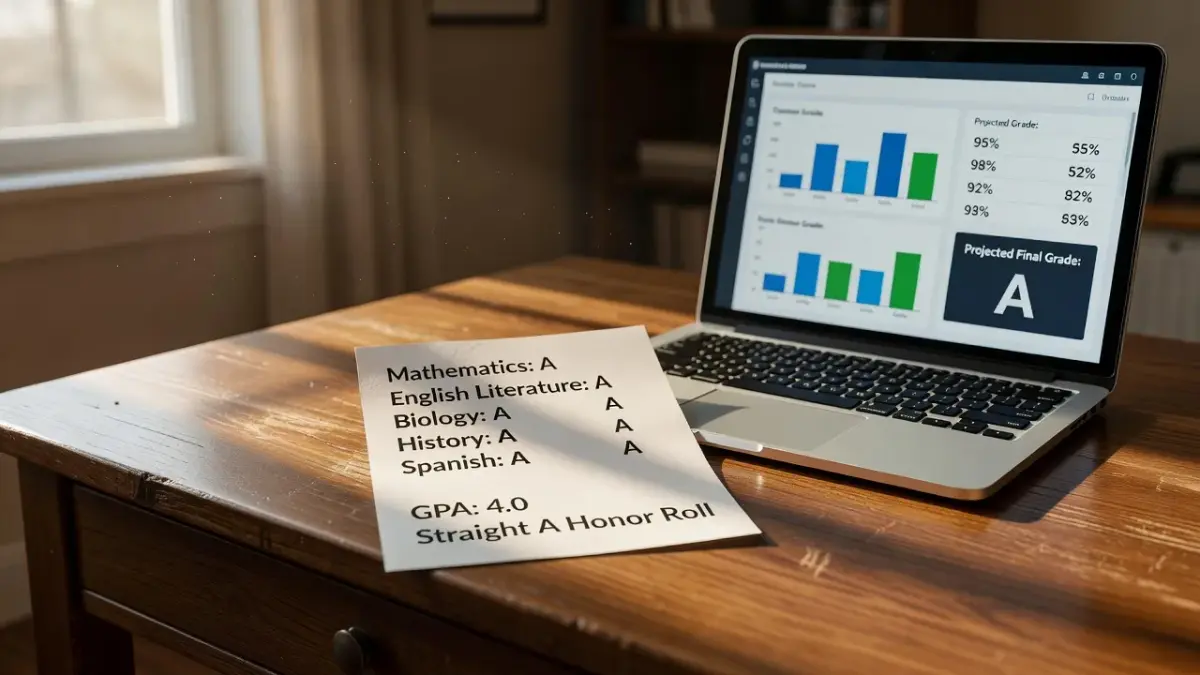
What do teachers say helps students get straight A's?
Teachers report that consistent rubric adherence, early clarification on difficult topics, and active classroom participation are the top behaviors behind straight-A performance. Educators regularly note that high-performing students rarely possess secret intelligence; instead, they treat assignment instructions like strict contracts.
Key habits observed by educators include:
- Rubric Alignment: Reading project rubrics before submitting work to ensure every point requirement is met.
- Proactive Office Hours: Asking questions two weeks before an exam rather than the night before.
- Consistent Submission: Turning in every low-stakes homework assignment to maintain a buffer against difficult exams.
When teachers grade papers, students who follow structural guidelines earn full credit on subjective points. Missing a single 10-point homework assignment forces you to score higher on heavy exams just to maintain an all As report card.
What do straight-A students say helps them get A's?
Straight-A students attribute their academic success to strict time management, active note-taking, and studying in focused, short intervals. High achievers rely on operational systems rather than late-night cram sessions.
Student-tested strategies include:
- The Pomodoro Technique: Working for 25 minutes followed by a 5-minute break to prevent mental fatigue.
- Daily Task Batching: Scheduling specific blocks for math problems, reading, and lab reports every afternoon.
- Self-Testing Over Re-Reading: Testing themselves with blank flashcards instead of passively skimming highlight lines.
Successful students recognize that maintaining high marks across six classes requires systematic planning. If you struggle to convert your raw percentages into letter grades while managing multiple classes, running your scores through a letter grade calculator eliminates guesswork.
Which study strategies improve academic performance, according to Dunlosky's learning techniques review?
Dunlosky's comprehensive 2013 review evaluated ten popular study techniques and found that retrieval practice and distributed practice offer high utility, while highlighting and re-reading offer low utility. Published in Psychological Science in the Public Interest, the review analyzed decades of educational research to determine which learning habits actually drive higher exam scores.
Each utility level is paired with two techniques, joined by a plus sign (+).
| Utility level | First technique | Second technique (+) |
|---|---|---|
| HIGHEST UTILITY | Practice Testing / Retrieval | Distributed / Spaced Practice |
| MODERATE UTILITY | Elaborative Interrogation | Self-Explanation |
| LOWEST UTILITY | Highlighting / Skimming | Re-Reading Textbooks |
The review categorized techniques into three clear utility tiers:
- High Utility: Practice testing (retrieval practice) and distributed practice (spacing study sessions over time).
- Moderate Utility: Elaborative interrogation (asking why a fact is true) and self-explanation.
- Low Utility: Highlighting text, re-reading passages, summarization, and keyword mnemonics.
Students aiming for a report card with all A's often spend hours highlighting textbooks, yet research proves this habit produces minimal retention. Shifting effort from low-utility skimming to high-utility self-testing is the fastest way to raise exam grades without spending extra hours at your desk.
How effective is retrieval practice for learning?
Retrieval practice is exceptionally effective because forcing the brain to recall information strengthens neural memory pathways far better than passive re-reading. According to cognitive research synthesized by the Association for Psychological Science, practice testing forces your mind to retrieve facts, which hardens that knowledge against memory decay.
Effective retrieval techniques include:
- Practice Exams: Completing past test papers under timed conditions without looking at answer keys.
- Flashcard Systems: Using physical flashcards or digital apps to test definitions and formulas daily.
- The Feynman Method: Explaining a complex concept aloud from memory on a blank sheet of paper.
When you practice retrieving concepts before an exam, you simulate the exact cognitive stress of test day. This process reveals knowledge gaps immediately, giving you time to correct misunderstandings before they show up on your permanent transcript.
How effective are spaced repetition and distributed practice?
Spaced repetition and distributed practice are highly effective strategies that increase long-term memory retention by spreading study sessions across days or weeks instead of cramming. Research compiled by the National Center for Education Statistics shows that spacing study intervals yields significantly higher academic retention than single, long cram sessions.
To implement distributed practice across your academic schedule:
- Space Review Windows: Study a topic on Day 1, review it on Day 3, test yourself on Day 7, and revisit it on Day 14.
- Cap Daily Subject Time: Limit study blocks to 45 minutes per subject per day rather than 4-hour weekend blocks.
- Interleave Topics: Mix related topics (like switching between algebra and physics problems) during a single study session.
Cramming the night before an exam might help you pass a single quiz, but the information vanishes shortly after. Spaced practice ensures that knowledge carries over to comprehensive final exams, protecting your all As report card at the end of the term. Strong terms also matter in college, so check typical Dean's List GPA requirements early.
Tracking Your Path to an All-A Report Card
Keeping straight A's requires clear numerical tracking so you know exactly what scores you need on final exams and major projects. Many students assume they have an A in a class until an unweighted grade drops right before report cards close.
When managing complex high school or college grading scales, tracking your progress requires comparing different monitoring options:
| Grade Tracking Method | Workflow Fit | Strengths | Limitations |
|---|---|---|---|
| Manual Paper Ledger | Fits offline daily habit tracking by hand in a notebook. | Zero screen distractions; tactile habit builder. | Prone to calculation errors; slow to update complex weights. |
| GradeMath GPA Calculators | Fits into daily or term-based tracking to project target grades and calculate exact weighted or unweighted GPAs. | Handles honors/AP weights; calculates cumulative totals; free to use. | Requires manual entry of individual grade inputs. |
| School LMS (Canvas/PowerSchool) | Fits automated real-time assignment monitoring from teachers. | Official grade record; automatically synced by school staff. | Weighting settings often misconfigured by individual teachers. |
| Basic Smartphone Calculator | Fits quick single-assignment percentage checks on the go. | Pre-installed on all phones; instant arithmetic. | Does not save class structures or handle credit-hour weighting. |
Using GradeMath alongside your school's portal helps you catch discrepancies before grades freeze. If your school uses weighted scales for advanced coursework, learning how to calculate gpa using current gpa gives you complete control over your final academic standing.
Does homework completion predict higher grades?
Yes, consistent homework completion strongly predicts higher academic grades, particularly for secondary school and college students. A landmark meta-analysis led by researcher Harris Cooper at Duke University, published by the American Psychological Association, demonstrated a direct positive correlation between homework completion and student achievement on standardized tests and class grades.
Homework Impact by Grade Level
| Grade Level | Impact |
|---|---|
| HIGH SCHOOL (9-12) | Strong positive correlation with grades |
| MIDDLE SCHOOL (6-8) | Moderate positive benefit on scores |
| ELEMENTARY (K-5) | Weak correlation; builds basic habits |
The study highlighted clear operational takeaways:
- Stronger Impact in Upper Grades: High school students derive a significantly stronger grade benefit from homework than middle or elementary students.
- The Optimum Time Threshold: High school performance gains peak around 1.5 to 2.5 hours of daily homework; exceeding this yield diminishing returns.
- Formative Feedback: Homework serves as low-stakes retrieval practice, identifying errors before high-stakes exams occur.
Skipping minor daily assignments drains your grade point cushion. Completing all assigned practice work provides a reliable safety margin if you perform below expectations on a difficult midterm.

What to Do If You Receive a Grade Below an A
If a B or lower appears on your mid-term update, immediately calculate the remaining points available in the term to determine if an A remains mathematically possible. A single lower grade does not mean your academic goals are out of reach, but you must react quickly before the grading period ends.
Take these structural steps as soon as a grade drops:
- Calculate the Percent Floor: Determine the exact score you need on remaining finals, labs, or essays to pull your class percentage back above 90% or 93%.
- Review Class Weighting: Check if your class uses total points or weighted categories (such as Exams 60%, Homework 20%, Quizzes 20%).
- Audit Graded Work: Check returned papers against scoring rubrics to verify that your points were added correctly.
- Request Extra Credit Early: Ask your teacher if supplemental credit options exist weeks before the term ends, not during the final week.
If you take AP or Honors classes, you can use our weighted gpa calculator to see how an A- or B+ affects your overall weighted average compared to your unweighted score.
Frequently Asked Questions
Is an A- considered part of a straight-A report card?
Yes, an A- is generally considered an A grade on most high school transcripts. However, on an unweighted 4.0 scale, an A- often carries 3.7 grade points instead of a full 4.0. This means your unweighted GPA may calculate to a 3.7 to 3.9 range depending on your school's specific grading scale.
Does a straight-A report card guarantee college admission?
No, a straight-A report card does not guarantee admission to elite universities, though it establishes a strong academic foundation. Admissions committees evaluate course rigor (such as AP, IB, or Dual Enrollment classes), standardized test scores, extracurricular leadership, and application essays alongside your GPA.
What is the difference between an unweighted 4.0 and a weighted 5.0 straight-A report card?
An unweighted 4.0 means you earned A grades across all classes regardless of difficulty, with every A capped at 4.0 quality points. A weighted 5.0 scale awards extra points (usually 0.5 for Honors and 1.0 for AP/IB courses), allowing students with all A's in advanced classes to earn a GPA above 4.0.
How do college admissions offices view a single B on a transcript?
College admissions offices view a single B as a minor variation within an otherwise strong academic record. Admissions officers prioritize your overall course rigor and trend lines over a single grade, especially if the grade occurred in an advanced college-level course.
How can I turn a B into an A before the term ends?
To turn a B into an A, calculate the total points remaining in the semester and aim for near-perfect scores on major weighted assignments like final exams and research projects. Meeting with your teacher to review previous mistakes ensures you correct fundamental errors before final assessments.
Does getting all A's in middle school affect college applications?
No, grades earned in middle school generally do not appear on high school transcripts sent to colleges. The only exception occurs when a middle school student takes high-school-level courses for credit, such as Algebra I or Spanish I, which may carry over to your official high school record.